
A Practical Toolkit for Cultivating Happiness in Communities

How the Happiness in Practice project turned months of workshops, listening circles and shared meals into an open resource for educators across Europe
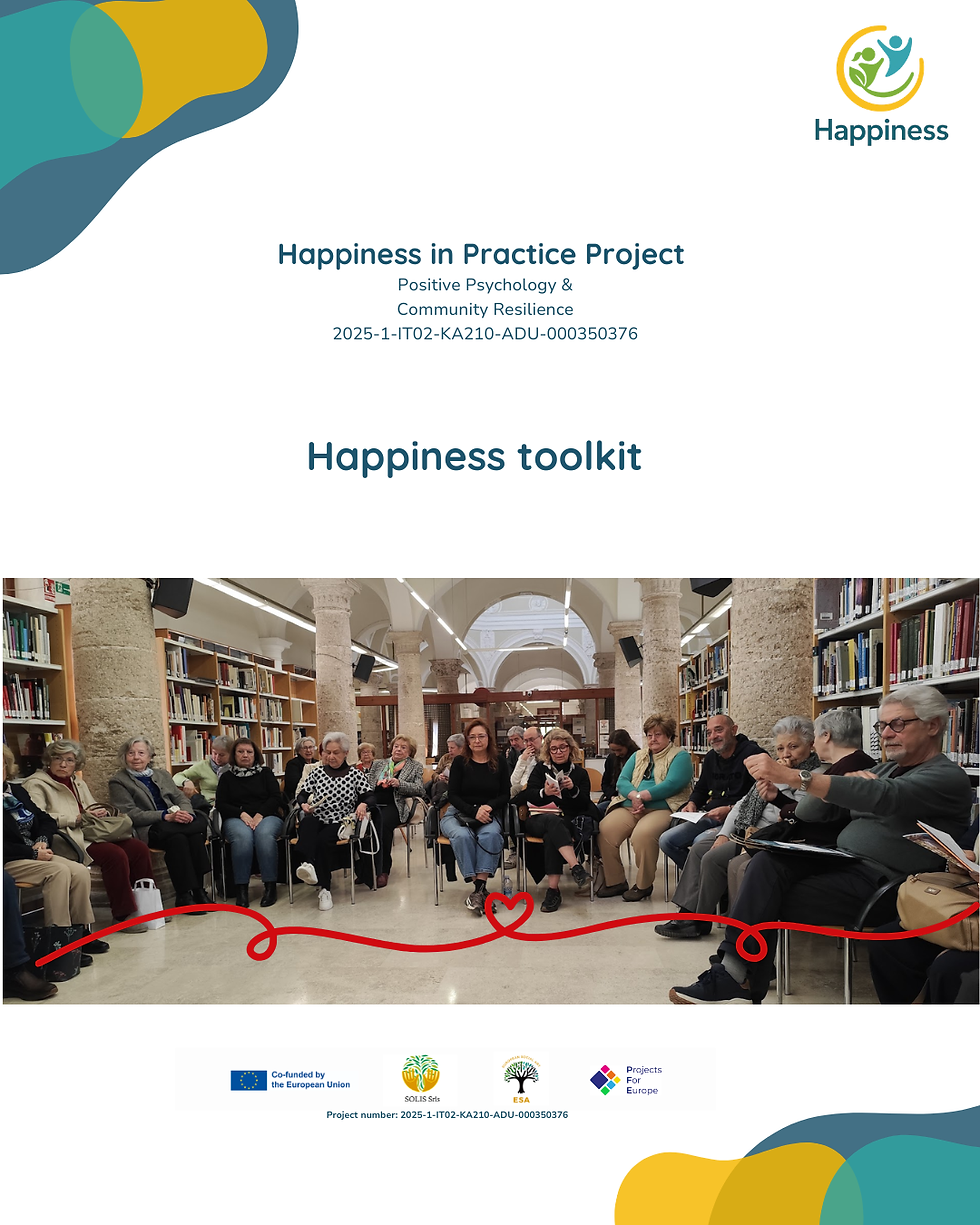
Happiness is not a destination, and it is rarely something people arrive at on their own. It is built slowly — in conversations that don't rush, in groups where someone bothers to ask how you really are, in cultural spaces that welcome you back, in small daily gestures that quietly hold a life together.
That is the conviction behind Happiness in Practice project launched in September 2025 . And it is also the conviction behind our new open-access publication: the Happiness Toolkit, a 66-page guide that compiles everything we have learned, tested and refined throughout the project so far.
We created it so that other educators, facilitators and community organisations would not have to start from scratch.
Why this toolkit, and why now
Across Europe, emotional distress has become part of daily life for a growing share of the adult population. According to Flash Eurobarometer 530, 46% of people reported experiencing emotional or psychosocial problems in the past year — and more than half of them never sought professional help. The pressures of work, caregiving, financial uncertainty and isolation hit especially hard between the ages of 35 and 60, an age range that often falls between the cracks of public mental health support.
Therapy is essential, but it cannot be the only answer. There is a vast space — preventive, educational, community-based — that needs simple, well-designed tools. Tools that do not pathologise everyday struggle, that respect people's autonomy, and that bring well-being closer to where life actually happens: libraries, cultural centres, neighbourhood associations, adult education classrooms.
That is the space the Happiness Toolkit is built for.
What's inside
The toolkit is organised so that you can use as much or as little of it as you need. An experienced facilitator can jump straight to the activity sheets. A team designing a longer learning path can combine several tools with the help of the session planner. Someone new to the approach can start with the methodological framework.
At its heart are seven core activities, each one tested in our international workshops in Modena and Valencia:
Laughter Yoga — body activation and group cohesion. In Valencia, it helped a roomful of strangers from different countries become a participatory community within minutes.
Circle of Empathy — a structured listening practice where presence matters more than advice, and silence is welcome.
The Door — using Magda Szabó's novel as a "protected projective mirror" to talk about care, dignity, dependency and limits without anyone having to expose their own story.
The Red Thread — a simple symbolic tool that makes the invisible network of a group visible, passed from hand to hand.
Positive Psychology Practices — brief, evidence-based exercises drawn from the PERMA model (positive emotions, engagement, relationships, meaning, achievement).
Everyday Micro-practices — small, repeatable actions around self-care, gratitude, hope, kindness and connection that sustain the work between sessions.
The Community Emotional Map — a participatory tool that helps a group move from individual feeling to a shared picture of needs, tensions, resources and bonds in their community.
Alongside the activities, the toolkit offers four session planning models (from a 90-minute workshop to a three-session itinerary), a facilitator's guide with ethical guidelines, recommendations for adapting the approach to multilingual or intergenerational groups, work templates, and an extended version of the Community Emotional Map.
What we learned in Modena and Valencia
The toolkit is not a theoretical exercise. It carries the trace of two workshops where Italian, Spanish and Belgian partners worked side by side — and discovered things they had not planned to find.
In Modena, we learned that well-being has to be approached through the body and through presence, not only through conceptual explanation. We also learned that breaks, shared breakfasts and informal visits to cultural spaces are not peripheral to the educational process — they are part of it. Cohesion is not built only in formal sessions.
In Valencia, working with Magda Szabó's The Door opened an unexpectedly rich conversation. Italian participants leaned toward the internal, psychological dimension of the story; Spanish participants gave more weight to the social and power dimension. The cultural difference was not a problem to smooth over — it was a resource that expanded the group's collective understanding.
Valencia also reinforced something essential: empathy needs limits. Where is the line between helping and controlling? When can a well-intentioned intervention become a violation? These questions sit at the centre of the toolkit's ethical framework.
A clear ethical position
One thing the toolkit insists on, repeatedly, is what it is not. It is not therapy. It does not diagnose, treat or promise to "fix" anyone. It does not propose a universal formula for being happy.
What it offers instead is more modest and more sustainable: practices, languages and spaces for listening that help make everyday life more livable, more conscious and more connected to others. Participation is always voluntary. Depth is never forced. The facilitator's role is to hold the framework, not to interpret anyone's experience.
This educational, preventive, non-therapeutic positioning is what makes the toolkit safe to use in places that are not clinical — and what makes it genuinely useful to libraries, museums, community centres, adult education programmes and the many informal spaces where well-being can be quietly nurtured.
An invitation
The Happiness Toolkit is freely available for any educator, facilitator or community organisation who wants to bring this approach into their own context. It can be downloaded directly from our website, in English. Versions in other languages are on the way.
You don't have to use all of it. Start small. Pick one activity that resonates. Try it with a group you already work with. Observe what happens. Adapt without losing focus on the essentials — voluntary participation, gradual progression from the personal to the collective, multiple languages of expression, and the centrality of listening.
If this work matters to you, we would love for you to be part of the growing European community of practice that is forming around it. Replicating this toolkit is not about transferring a fixed model. It is about recreating, in each context, a way of working on well-being that combines listening, body awareness, connection, culture, participation and shared learning.
When that happens, even a small activity can spark something meaningful.


Comments