
First International Workshop in Modena

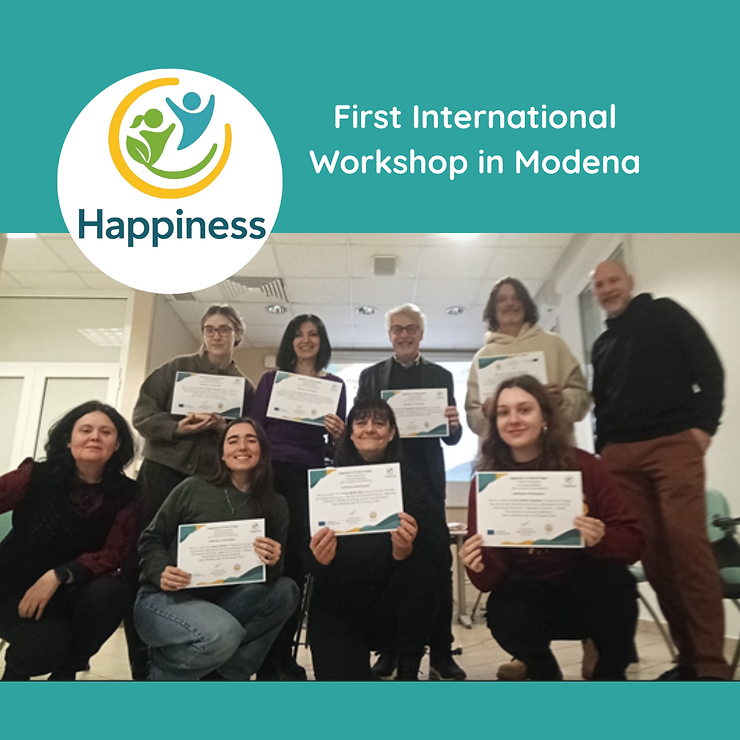
From 19 to 21 January 2026, the first International Workshop of the project Happiness in Practice – Positive Psychology & Community Resilience took place in Modena, Italy. The meeting represented a key milestone in the development of the project, as it laid the methodological, relational, and conceptual foundations for the transnational training process.
Hosted by SOLIS SRLS (Italy) with the patronage of the Municipality of Modena, the workshop brought together educators and facilitators from the project partner organisations European Social Art – ESA (Spain) and Projects for Europe – PFE (Belgium). Participants came from diverse professional backgrounds in adult education, facilitation, positive psychology, culture, and community work, fostering a rich interdisciplinary and intercultural exchange from the outset.
A shared methodological framework for well-being
The workshop was designed as an experiential, non-formal learning process, explicitly framed within an educational and preventive approach. Well-being was addressed not as a therapeutic or clinical concept, but as a set of competencies, practices, and relational processes that can be cultivated individually and collectively.
Across three intensive days, participants explored a shared methodological framework combining positive psychology, body-based practices, narrative approaches, empathic listening, and cultural engagement. The training pathway was structured to progressively build trust, presence, and group cohesion, creating a safe environment for learning, reflection, and co-creation among partners from Italy, Spain, and Belgium.
Day 1: Positive psychology, embodiment, and community perspectives
The first day focused on group building and the introduction of the project’s methodological foundations. Body- and movement-based activities were used to foster presence, mutual trust, and non-verbal communication within the international group.
Participants engaged in positive psychology activities aimed at exploring emotional needs, relational balance, and personal positioning in relationships. These sessions combined individual reflection, pair work, and small group exchanges, encouraging awareness of how well-being is shaped by both personal resources and relational dynamics.
In the afternoon, the focus expanded from individual and relational well-being to a broader community and cultural perspective. Through reflections on art, culture, and health, participants explored well-being as a process of care, memory, and collective renewal, drawing on experiences developed by European Social Art – ESA (Spain) in community and cultural contexts.
The day concluded with a cultural visit to a historic acetaia in Modena, offering a symbolic reflection on time, care, sustainability, and intergenerational transmission as key dimensions of well-being.
Day 2: Holistic well-being, body-based practices, and culture
The second day deepened the exploration of holistic well-being by integrating emotional, bodily, social, and cultural dimensions. Positive psychology activities focused on relational nourishment, recognition, and balance across different life domains, supporting the transfer of learning to both personal and professional contexts.
A central moment of the day was the experiential laboratory based on Laughter Yoga. Through conscious breathing, movement, and shared laughter, participants directly experienced how short and accessible body-based practices can support stress reduction, vitality, and social cohesion. The session highlighted the potential of transferable tools for use in adult education, community work, and social contexts across the partner countries.
The afternoon was dedicated to the role of culture as a resource for community health, further strengthening the connection between well-being, territory, and participation. The day concluded with a guided walk through Modena, reading the city’s urban heritage as a living space of identity, memory, and collective care.
Day 3: Narrative practices and Empathy Circles
The third day focused on integration and deepening processes, bringing together body awareness, narrative work, and empathic listening. Participants engaged in grounding exercises to promote presence and emotional regulation, preparing the group for more reflective and relational activities.
Through autobiographical narrative and collaborative writing, storytelling was explored as a symbolic and creative act capable of transforming personal experience into shared meaning. This work naturally led into the core practice of the day: the Empathy Circles.
The Empathy Circles provided a structured space for deep listening, based on principles of voluntariness, confidentiality, equity, and non-judgement. Participants experienced the difference between listening to respond and listening to understand, as well as the emotional and relational impact of being heard without interruption or advice. These practices reinforced trust, mutual recognition, and a strong sense of community among partners from SOLIS SRLS (Italy), European Social Art – ESA (Spain), and Projects for Europe – PFE (Belgium).
Collective synthesis and future steps
The workshop concluded with a collective synthesis and methodological alignment session coordinated by Projects for Europe – PFE (Belgium). Participants reflected on key learnings, identified shared principles, and discussed how to translate the methodologies tested in Modena into future activities and local contexts. This process ensured coherence, quality, and a shared vision among all project partners.
Overall, the Modena workshop established the foundations for a transnational community of practice grounded in trust, listening, and shared responsibility. By integrating body-based work, positive psychology, narrative approaches, cultural practices, and empathic listening, the meeting offered a comprehensive and transferable understanding of well-being as an embodied, relational, and community-based process.
The learnings, relationships, and agreements developed during this first international workshop provide a solid basis for the next phases of the project, with the upcoming international meeting scheduled to take place in Valencia.


Comments